European architecture tells the story of how people built, lived, worshipped, and expressed their ideas across centuries.
From the columns of ancient Greece and Rome to Gothic cathedrals, Baroque palaces, and detailed Victorian homes, every style reflects a different moment in history.
These buildings are more than old structures. They show changing cultures, religions, materials, and building techniques.
European architecture has also influenced homes, public buildings, and interiors far beyond Europe. Looking at its major styles and features helps explain why these designs still shape the way buildings are created today.
What is European Architecture?
European architecture refers to the architectural traditions that developed across Europe from ancient civilizations to the present day.
Rather than representing a single style, it includes a collection of movements that evolved over centuries in response to changing cultures, religions, technologies, and artistic ideas.
Although each region developed its own architectural identity, many European buildings share common characteristics such as balanced proportions, durable materials, decorative craftsmanship, and thoughtful design.
These qualities have influenced architecture far beyond Europe, inspiring homes, government buildings, churches, museums, and landmarks worldwide.
Evolution and Major Styles of European Architecture
European architecture grew over more than 2,000 years, shaped by different rulers, religions, and building methods. Each era added new ideas, from Roman arches to Gothic spires.
1. Classical Foundations

Classical architecture began in Greece around the eighth century BCE and lasted through the fifth century CE in Rome. Greek builders created the Doric, Ionic, and Corinthian column styles, which are still copied today.
Romans later added concrete, arches, and domes, a material still prized in modern concrete homes, allowing them to build larger temples and public halls.
This early style set the rules for symmetry and proportion that shape government buildings, museums, and universities across the world.
2. Byzantine Architecture
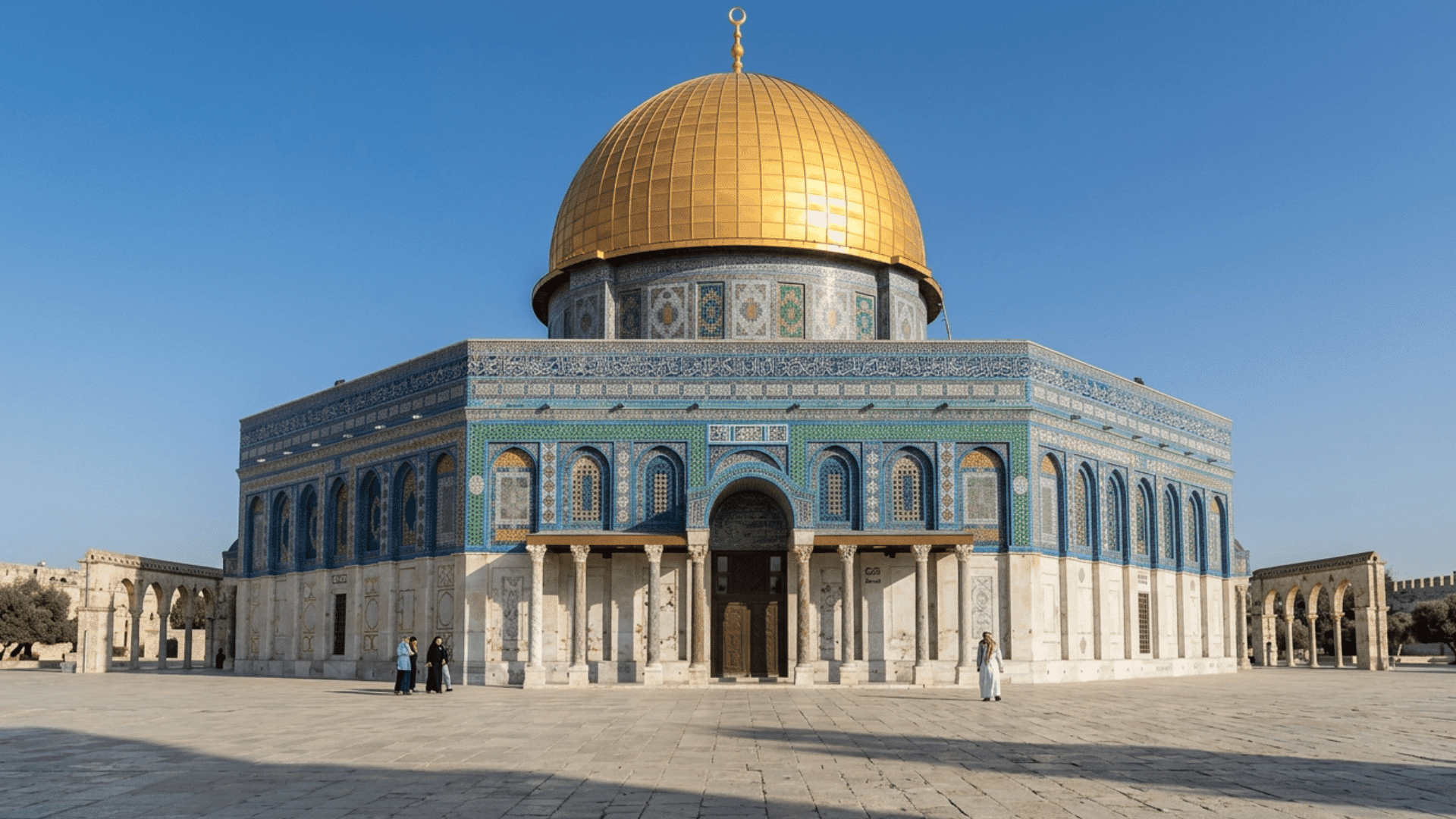
Byzantine architecture grew out of the Eastern Roman Empire from around 330 to 1453. Builders kept Roman arches and engineering but added huge domes, colorful mosaics, and marble walls covered in Christian art.
The best example is Hagia Sophia, once the largest church in the world for nearly a thousand years. This style later shaped Orthodox churches and even influenced mosque designs across the Middle East and Eastern Europe.
3. Romanesque to Gothic Architecture
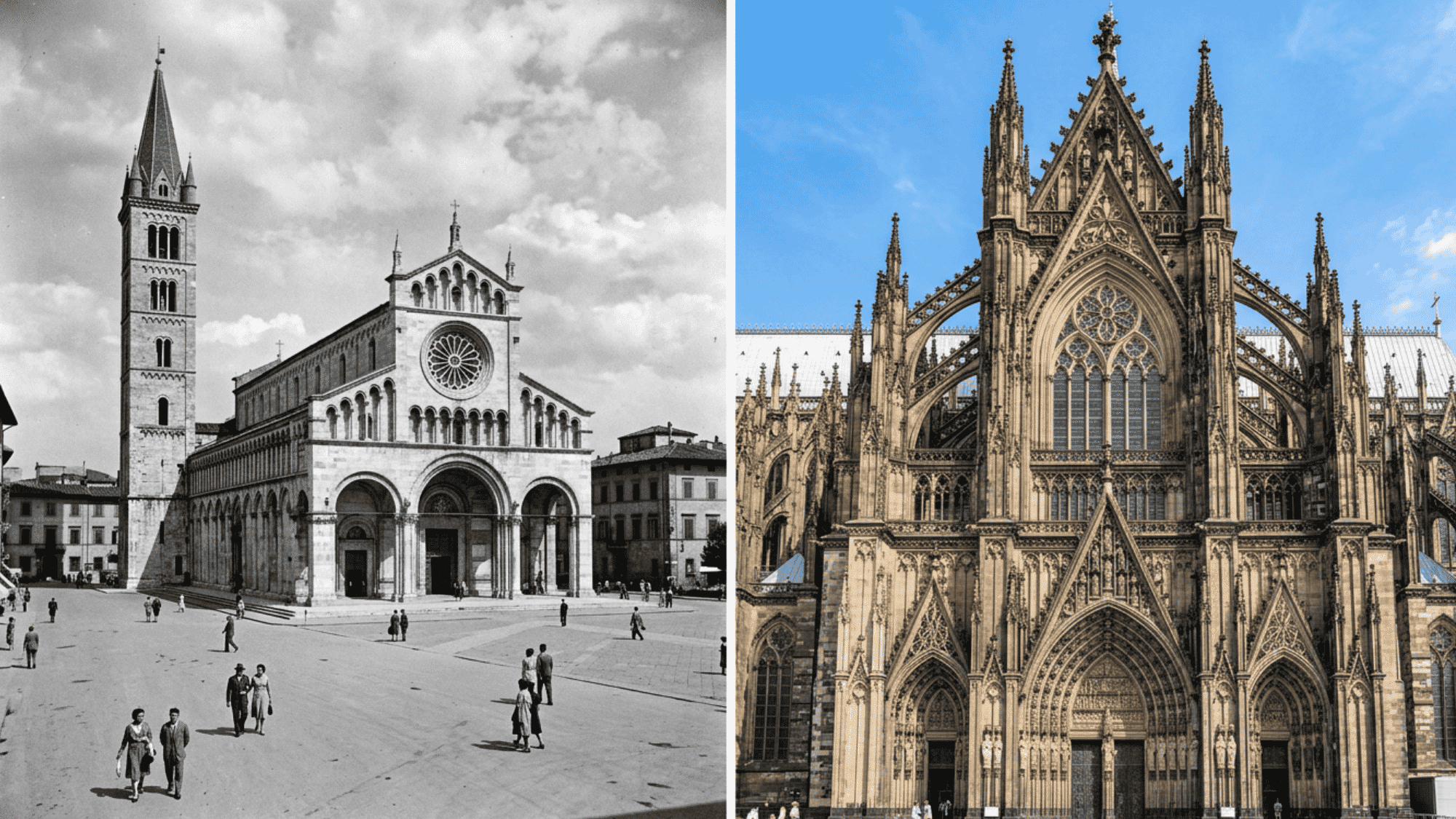
Romanesque architecture ruled from the 9th through 12th centuries. It’s known for thick walls, small windows, and rounded arches built to survive attacks. Gothic architecture followed from the 12th through the 16th centuries.
It flipped the formula with pointed arches, ribbed ceilings, and flying buttresses supporting soaring stained-glass walls. Together, these styles turned churches and castles into daring engineering projects.
4. Renaissance to Baroque Architecture
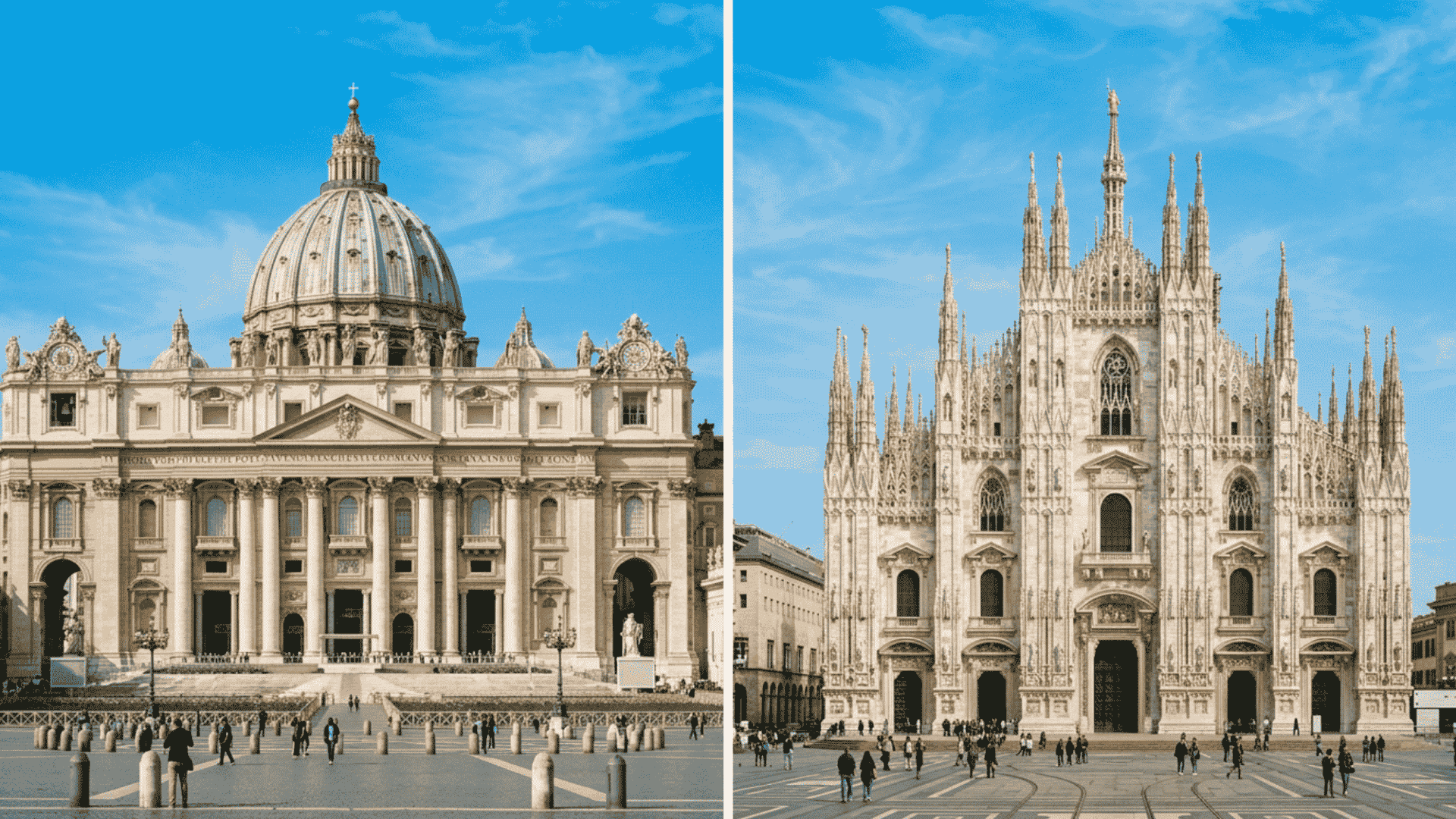
Renaissance architecture began in Florence in the early 15th century. It spread across Europe through the 17th century, reviving Greek and Roman ideas like symmetry, balance, and rounded domes. Baroque architecture took over from the 17th through the 18th centuries.
It replaced calm balance with dramatic curves, grand staircases, and richly decorated ceilings. Historians often trace the movement back to early Florentine buildings, where wealthy families funded bold new designs.
5. Neoclassical Architecture

Neoclassical architecture rose from the mid-18th through the 19th century as a reaction against busy Baroque and Rococo decoration.
Builders returned to simple Greek and Roman shapes: columns, pediments, and clean symmetry with little extra ornament. Berlin’s Brandenburg Gate, finished in 1791, remains one of the clearest examples.
This style shaped many European museums, government buildings, and monuments before newer movements took over in the 20th century.
6. Georgian to Victorian Architecture
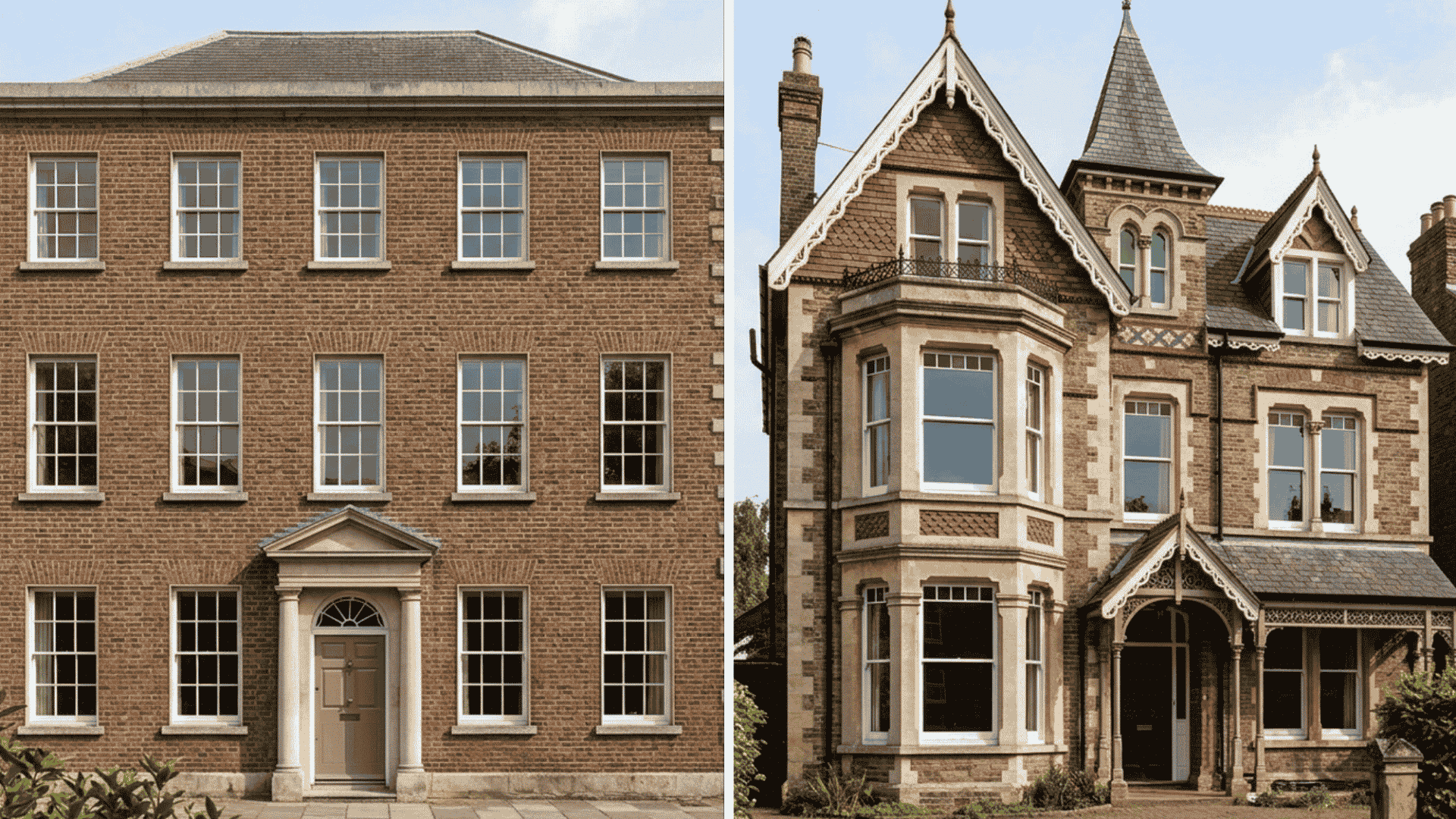
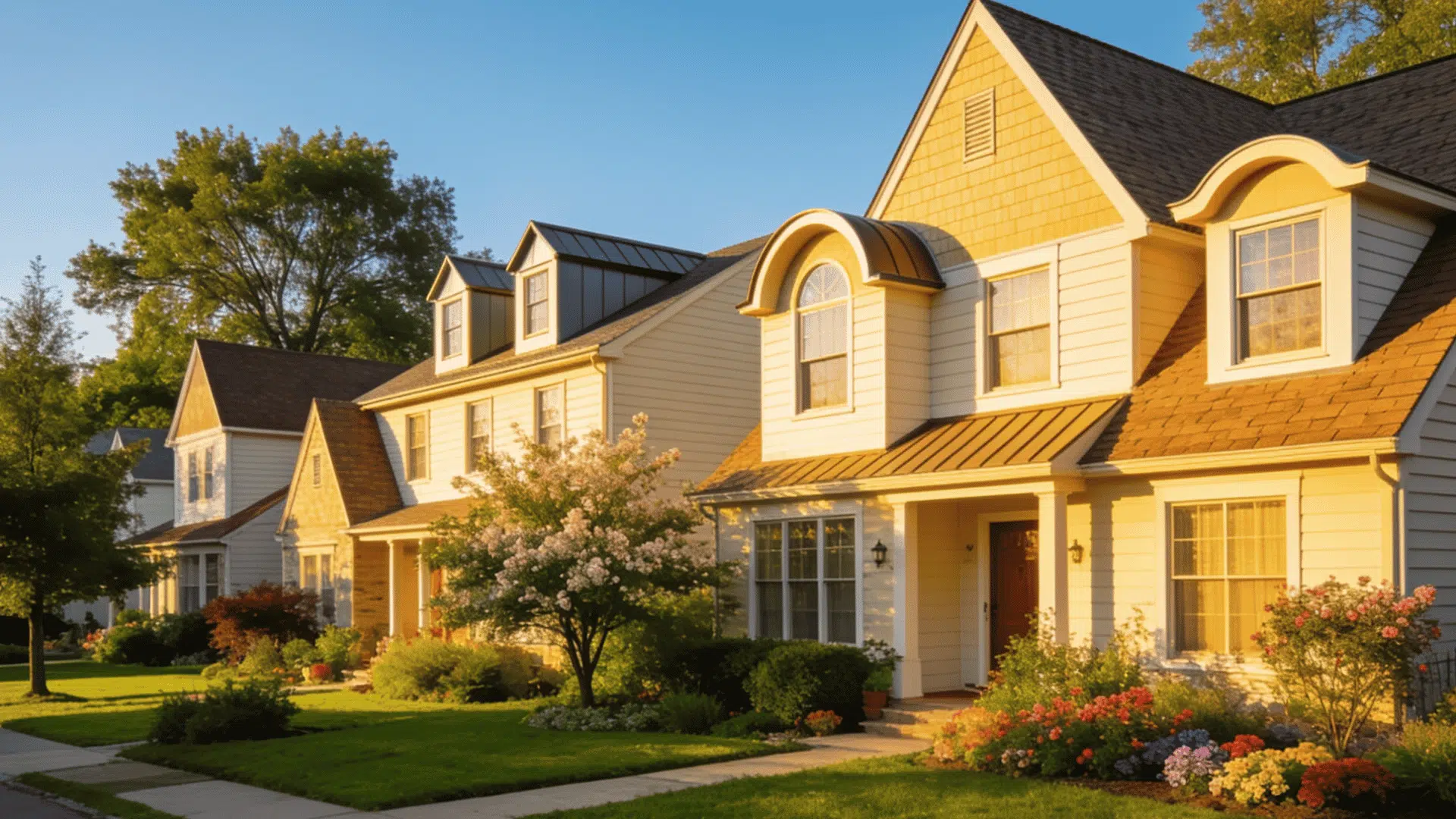
Georgian architecture spanned 1714 to 1830, giving Britain symmetrical brick homes, tall sash windows, and simple classical trim. The Victorian period followed from 1837 to 1901.
It brought back heavy ornament: steep roofs, bay windows, towers, stained glass, and patterned brickwork. Together, these two periods show a clear shift from Georgian restraint to Victorian confidence.
Both styles still shape how homes look across Britain and much of Europe today.
7. Art Nouveau, Art Deco, and Modern Influence
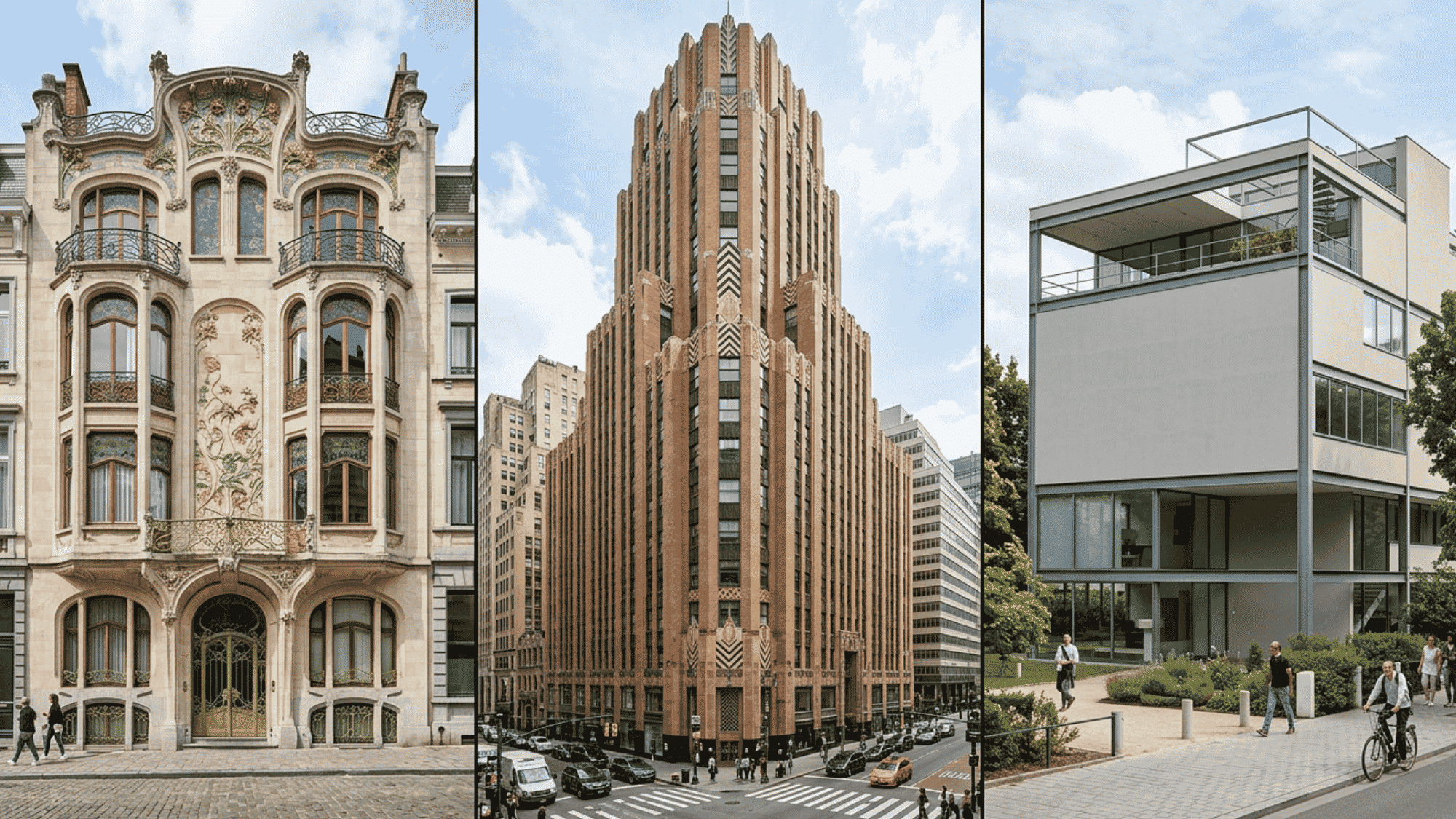
Art Nouveau flourished from about 1890 to 1914, filling buildings with flowing lines and plant-like patterns inspired by nature, and many surviving Art Nouveau architecture examples still influence restored homes today.
Art Deco followed through the 1920s and 1930s, swapping soft curves for bold geometric shapes and streamlined symmetry. Modernism then spread across the 20th century, favoring plain surfaces and function over decoration.
Each movement pushed European design toward simpler forms while keeping earlier craftsmanship alive.
Signature Design Elements of European Architecture
While each architectural movement has its own identity, many European buildings share design features that have stood the test of time.
1. Symmetry and Balanced Proportions
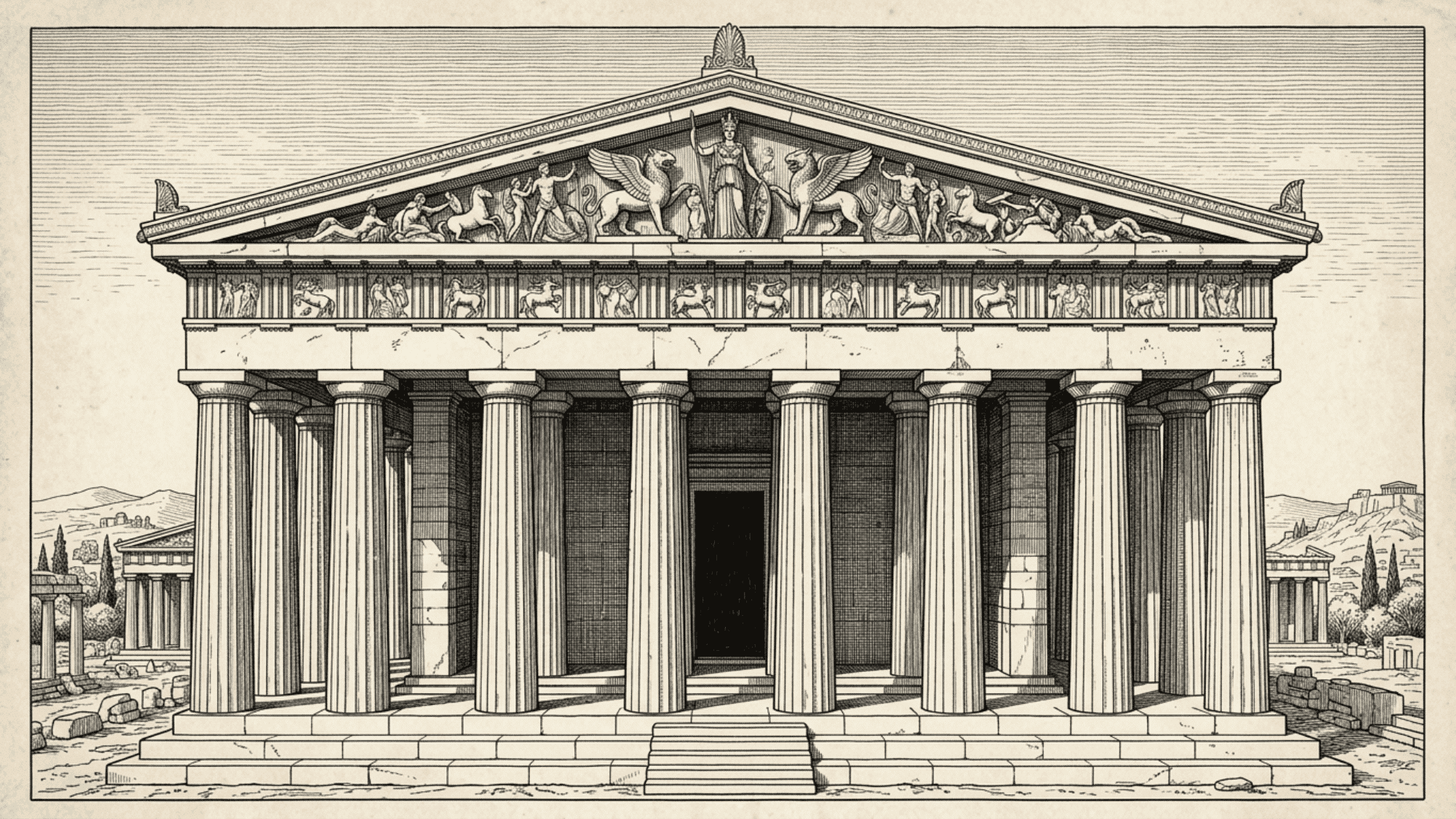
Symmetry’s basically the backbone of Classical, Renaissance, and Georgian design. Matching windows. A centered door. Details spaced out evenly, nothing crowding anything else.
As an interior designer, I’ll say this plainly: proportion does more heavy lifting than decoration ever will. People notice when a room feels “off” way before they notice why.
That’s a big reason European-inspired homes never really go out of style. They’re not chasing a trend to begin with.
2. Arches, Columns, and Entrances
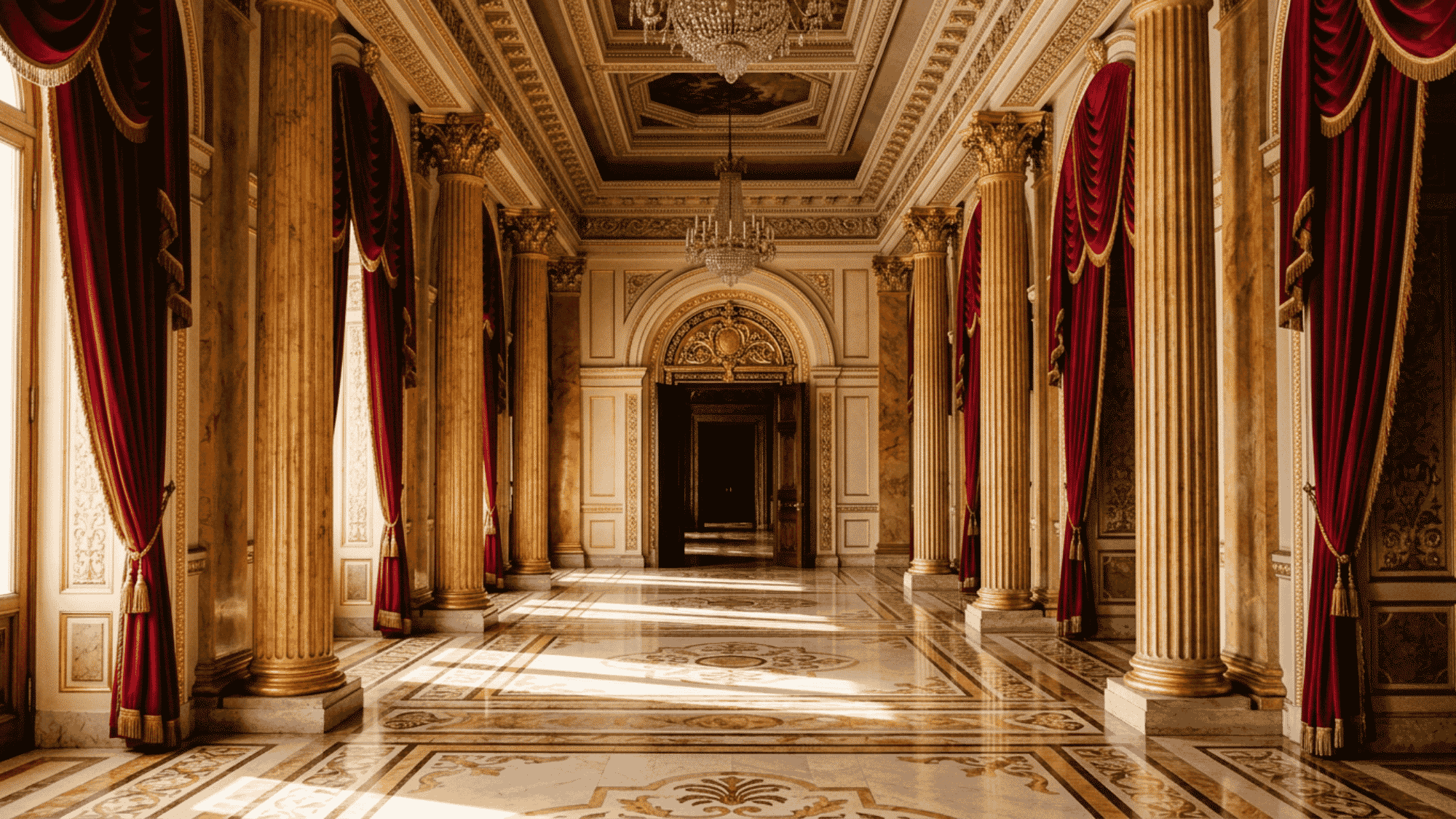
Columns and arches. Probably the most recognizable shapes in the whole tradition, honestly. Greeks and Romans used columns as a flex of strength, beauty, and status, all rolled into one shape.
Romanesque and Gothic builders later figured out arches could do double duty: hold the weight up and look incredible doing it.
Which is exactly why hotels, civic buildings, and luxury homes still use this stuff.
It says “permanent” without a single word.
3. Decorative Trim, Sculptures, and Stone Carvings
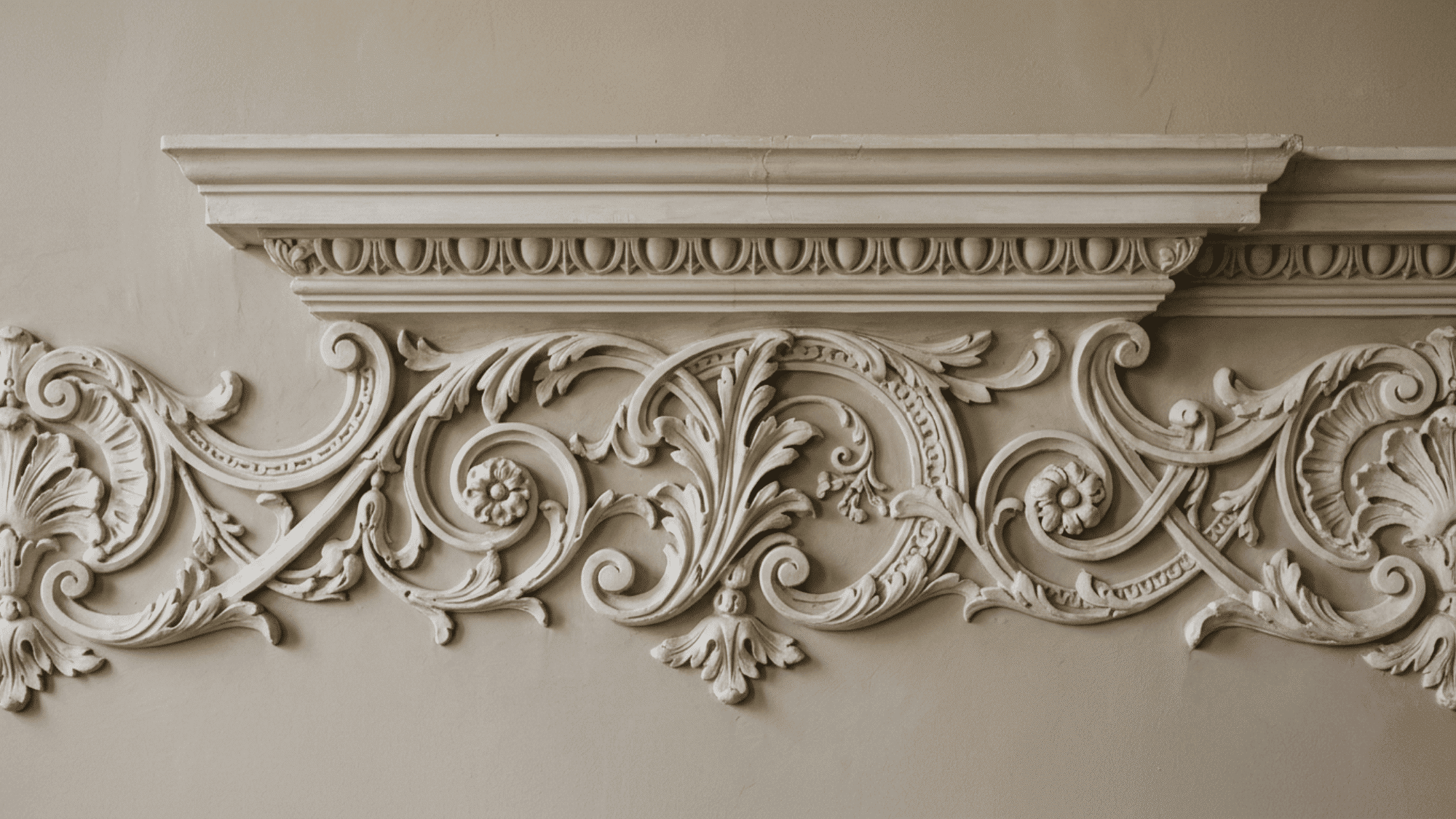
Carved cornices, Ceiling medallions, Stone reliefs, Woodwork so intricate you wonder how long one panel took. All of it adds texture that a flat wall just can’t fake.
Old churches and palaces are covered in statues and carved scenes that tell real stories: religious, historical, sometimes both tangled together. Beyond looking good, this stuff shows off real hands-on skill.
It gives a building a personality most minimalist design skips entirely.
4. Domes, Spires, Towers, and Decorative Ironwork
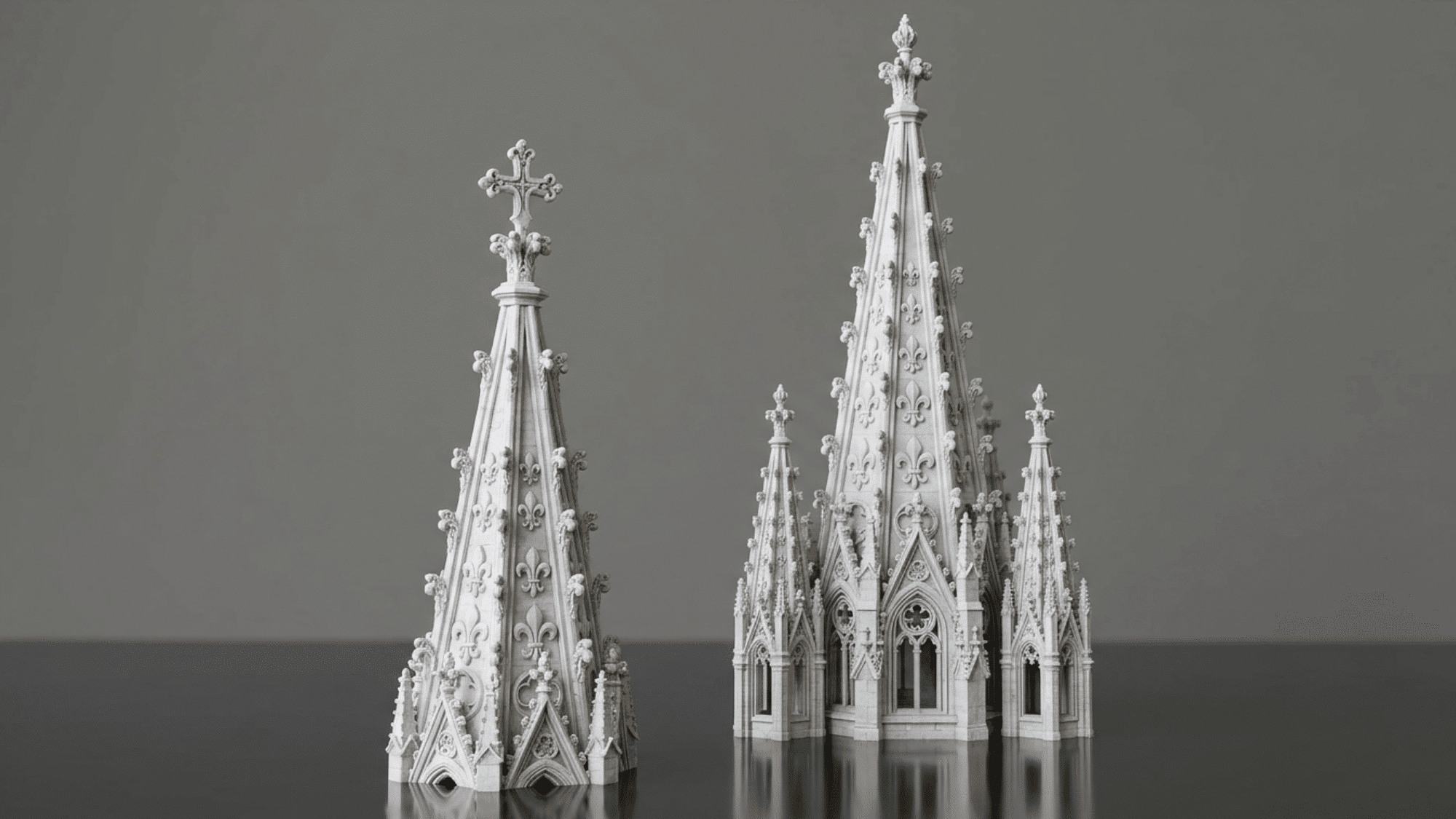
Some of Europe’s most famous landmarks are basically defined by how tall they dare to get. Cathedral spires. Domes. Clock towers. Castle turrets.
All of it pulling your eyes upward, shaping entire skylines in the process. Then there are the ironwork balconies, gates, railings, window grilles, all handmade, all adding one more layer of detail nobody was forced to include.
Put it together, and that’s why European-style buildings still feel distinct, whether they went up five hundred years ago or five months ago.
European Architecture Styles Compared
Each European architectural style left its own mark on history. This table lines them up side by side, showing when each one began and what made it stand out.
Style | Time Period | Defining Features | Iconic Examples |
|---|---|---|---|
Classical | 8th Century BCE – 5th Century CE | Columns, pediments, symmetry | Parthenon, Greece |
Byzantine | 4th – 15th Century | Domes, mosaics, Christian art | Hagia Sophia, Turkey |
Romanesque | 9th – 12th Century | Rounded arches, thick stone walls | Speyer Cathedral, Germany |
Gothic | 12th – 16th Century | Pointed arches, stained glass, flying buttresses | Notre-Dame Cathedral, France |
Renaissance | 15th – 17th Century | Domes, columns, balanced proportions | St. Peter’s Basilica, Italy |
Baroque | 17th – 18th Century | Dramatic ornamentation, sculptures, curved façades | Palace of Versailles, France |
Neoclassical | 18th – 19th Century | Columns, pediments, restrained symmetry | Brandenburg Gate, Germany |
Georgian | 18th – 19th Century | Brick façades, sash windows, symmetry | Royal Crescent, England |
Victorian | 19th Century | Bay windows, towers, decorative trim, Gothic Revival detailing | Palace of Westminster, England (Gothic Revival) |
Art Nouveau | Late 19th Century | Flowing curves, floral motifs | Casa Batlló, Spain |
Art Deco | Early 20th Century | Geometric forms, streamlined design | Palais de Chaillot, France |
Famous Examples of European Architecture
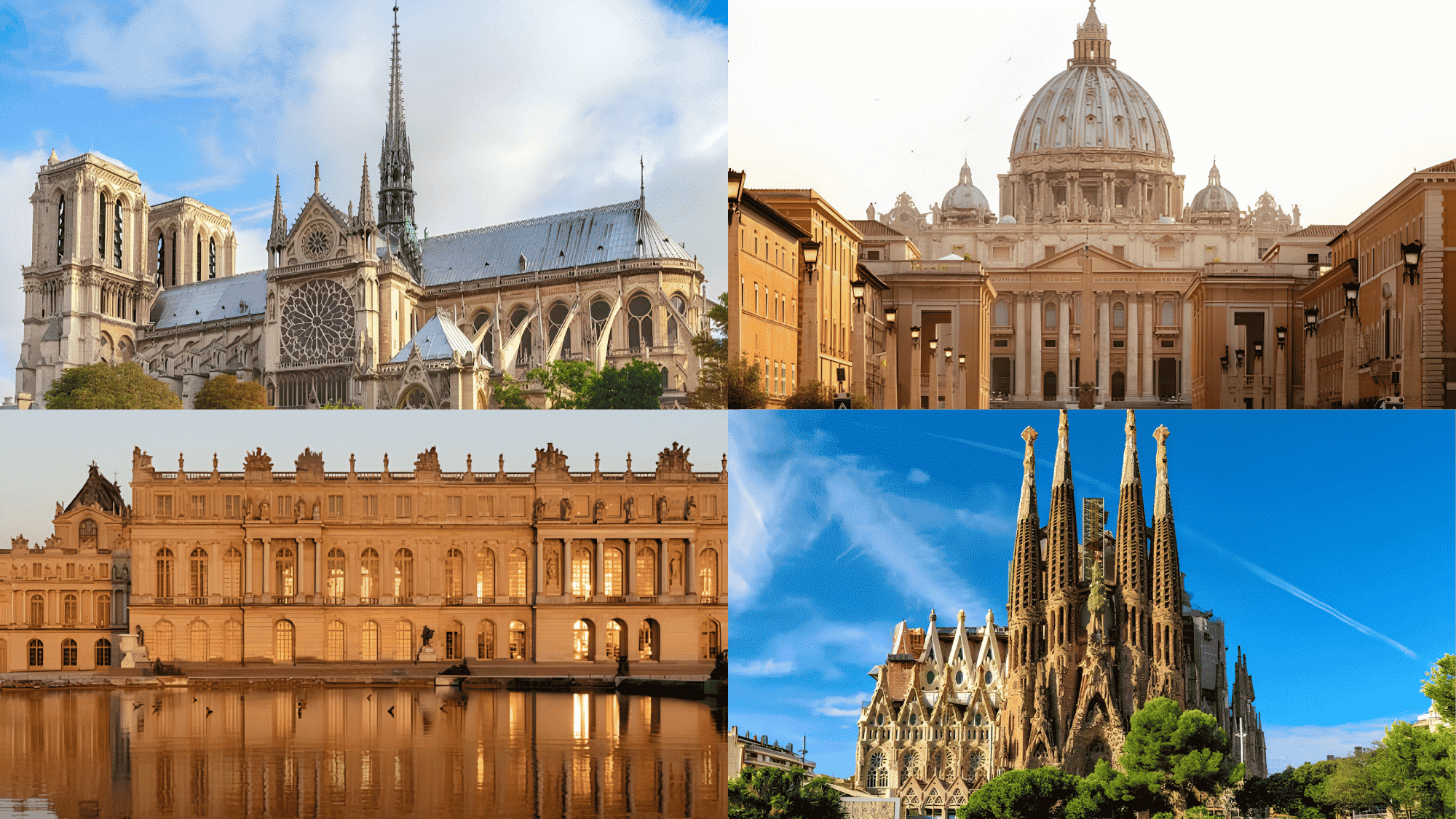
Europe’s most famous buildings show these styles in real life. Each one took decades, sometimes centuries, to finish. Together, they prove how much skill and patience went into European design.
1. Notre-Dame Cathedral, France
Builders began construction on Notre-Dame Cathedral in 1163 and finished it around 1345. They used pointed arches and flying buttresses to hold up tall stone walls filled with glass. A fire badly damaged the roof and spire in 2019.
The cathedral reopened in December 2024 after a five-year rebuild. Its huge rose windows survived the flames and still draw crowds today. It remains one of the most visited landmarks on the continent.
2. St. Peter’s Basilica, Italy
Builders worked on St. Peter’s Basilica in Vatican City from 1506 to 1626, more than a hundred years in total. Donato Bramante planned the original design, and Michelangelo later shaped the massive dome.
Carlo Maderno added the long nave and front, while Gian Lorenzo Bernini designed the round piazza outside. This mix of Renaissance planning and Baroque flair makes it the largest church in the world by inside space.
3. Palace of Versailles, France
King Louis XIV turned a small hunting lodge into the Palace of Versailles between 1661 and 1710. The result was the grandest home in Europe.
Louis Le Vau and later Jules Hardouin-Mansart designed the sprawling building, while André Le Nôtre laid out its famous gardens.
Inside, gilded ceilings, sweeping staircases, and the Hall of Mirrors show Baroque style at its boldest. The palace still ranks among Europe’s most visited royal sites.
4. Sagrada Família, Spain
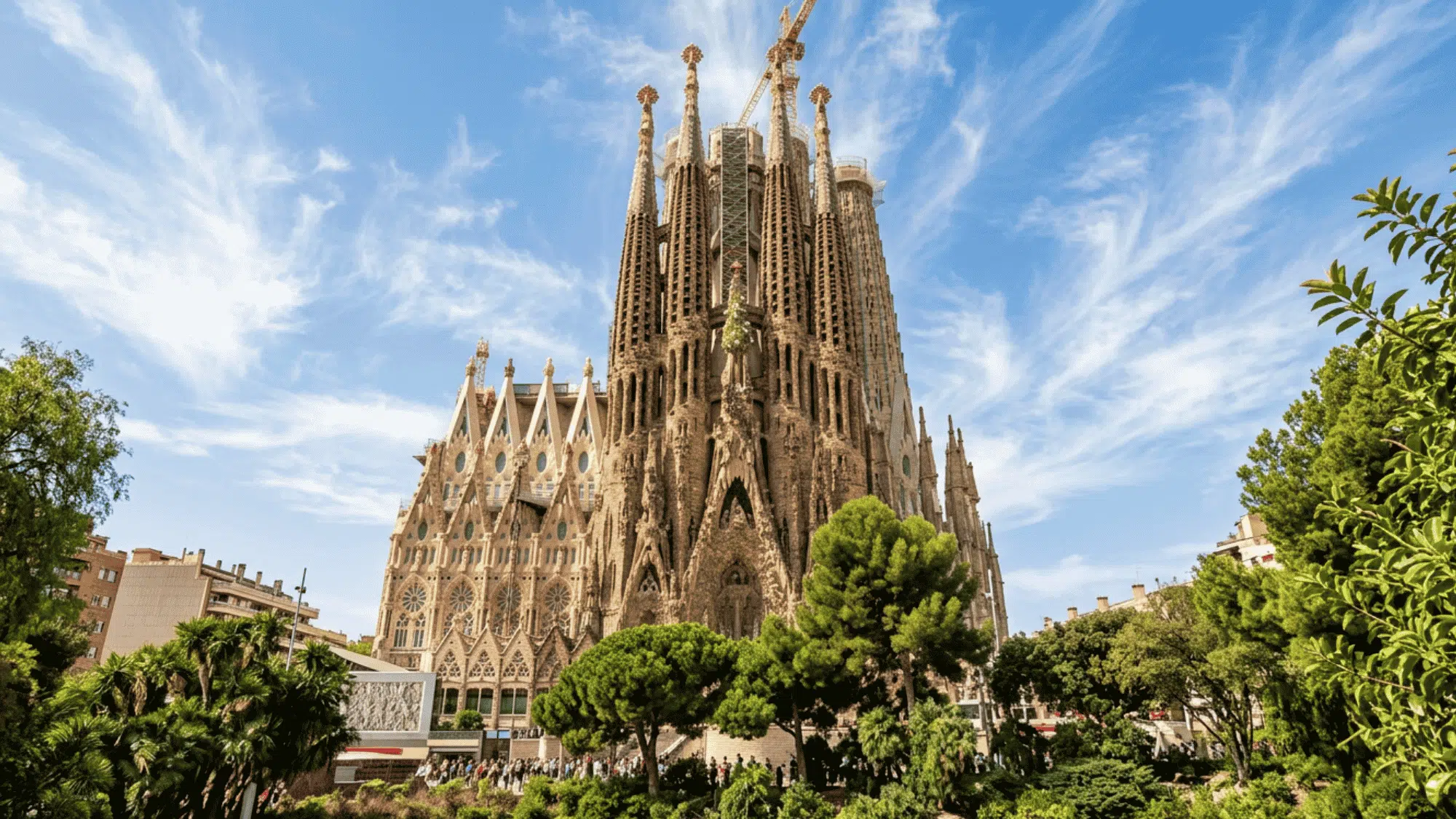
Construction on the Sagrada Família began in 1882. Antoni Gaudí took charge in 1883. He spent over 40 years shaping its style, blending Gothic Revival and Art Nouveau ideas. Soaring spires, detailed façades, and colorful stained glass fill the basilica.
In February 2026, its central tower reached full height, making Sagrada Família the tallest church in the world. Full completion of the remaining details is expected closer to 2034.
How European Architecture Continues to Shape Modern Design
Although many of Europe’s architectural styles originated centuries ago, their influence remains visible in contemporary homes, hotels, and public buildings.
Designers still embrace symmetry, natural materials, and balanced proportions for timeless, functional spaces.
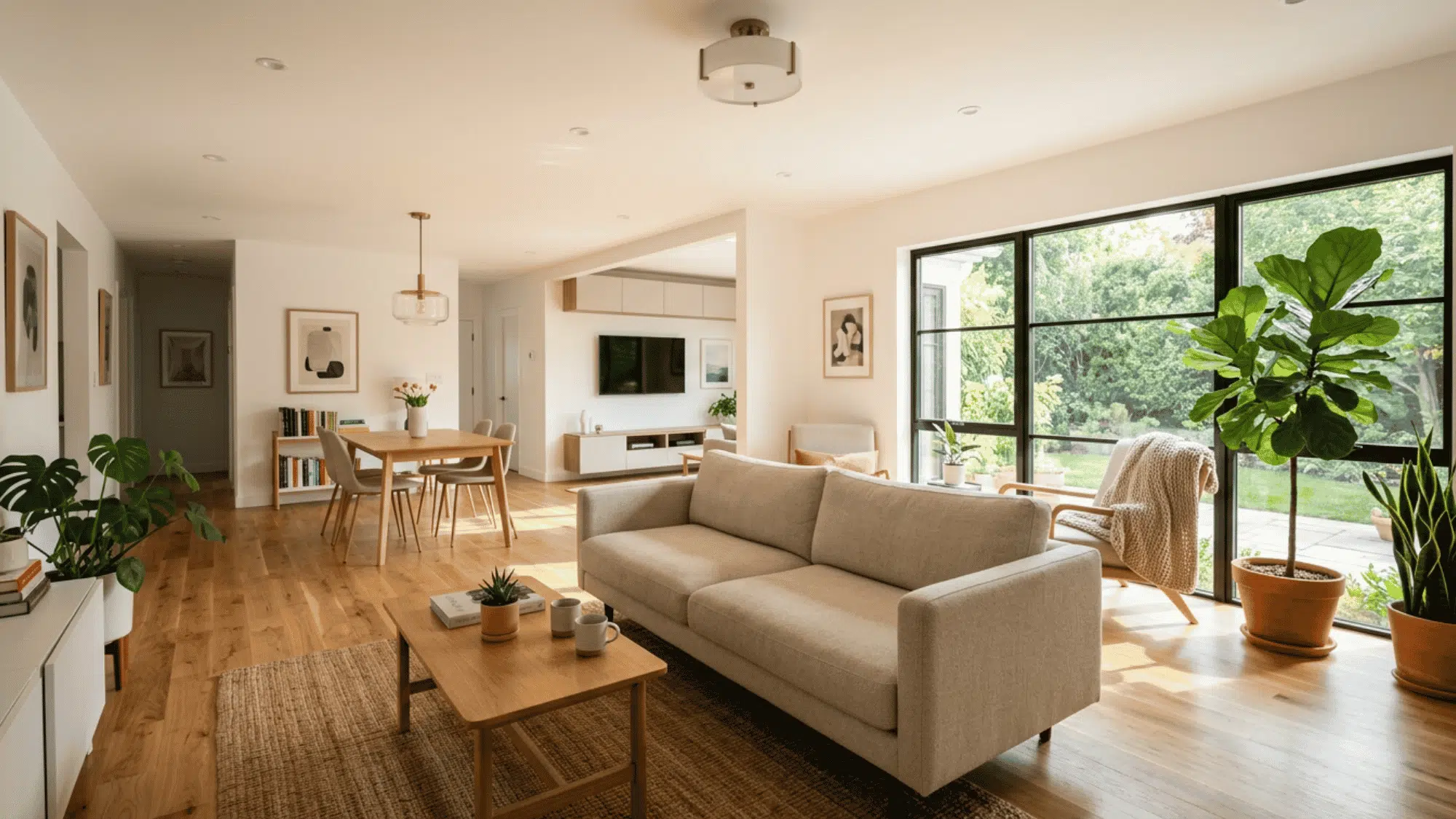
Rather than copying historic buildings exactly, modern architecture often reinterprets these elements through cleaner lines, larger windows, and open floor plans.
This thoughtful blend of traditional craftsmanship and modern living allows homeowners to enjoy the character of classic European architecture without sacrificing comfort or practicality.
How to Bring European Architecture Into Your Home
Creating a European-inspired home is less about copying a specific palace or cathedral and more about using design features associated with the architectural style you prefer.
Add details such as crown molding, paneled doors, arched openings, or statement lighting to introduce character without overwhelming the space.
Well-proportioned rooms and carefully selected architectural details can create a stronger European influence than adding too many decorative accessories.
Choosing quality materials and skilled craftsmanship can also help create a home with lasting character.
Final Thoughts
European architecture has changed greatly over the centuries, but each period has left a clear mark on the buildings we see today.
Classical columns, Gothic arches, Renaissance balance, Baroque detail, and modern forms all reflect the ideas and needs of their time. Together, these styles show how architecture can record history while continuing to inspire new designs.
Learning about European architecture also makes it easier to recognize the features behind famous landmarks and everyday buildings. From historic cathedrals to modern homes, its influence remains easy to spot.
Which European architectural style do you like most? Share your favorite in the comments below!
Frequently Asked Questions
What is Considered the Most Beautiful Architecture in Europe?
Beauty is subjective, but Notre-Dame, St. Peter’s Basilica, Sagrada Família, and the Palace of Versailles are consistently named among Europe’s most admired buildings, each showing a different style at its most refined and ambitious.
Is Gothic Architecture Still Used in Buildings Today?
Pure Gothic buildings are rare now, but its features never disappeared. Pointed arches, tall windows, and ribbed vaults still appear in churches, universities, and government buildings, especially in Gothic Revival buildings from the 1800s.
What is the Difference Between Baroque and Rococo Architecture?
Baroque favors bold curves, heavy ornament, and dramatic lighting meant to impress and inspire awe. Rococo grew out of it but leans lighter, using pastel colors and fine detail suited to private homes, not churches.